Project Progress: Multi-Stage Forming of High-Strength Aluminum Alloys
14.08.2023The EN AW-7075 aluminum alloy offers great potential for lightweight construction but has very limited cold formability. For this reason, the investigation of temperature-assisted process routes to improve formability has been and continues to be the focus of various national and international research efforts — including those at Werner Schmid GmbH.
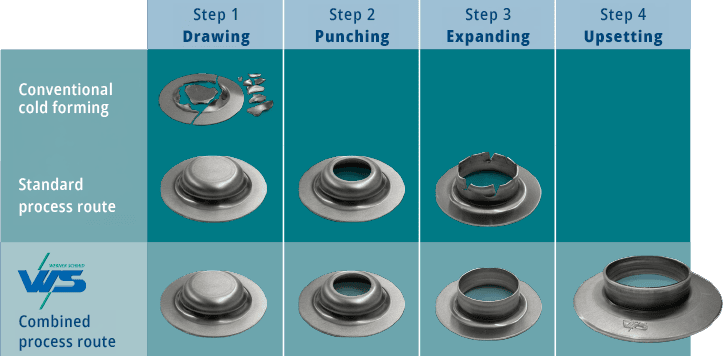
For the past four years, Werner Schmid has been conducting a research project in collaboration with the technical university of Darmstadt. The focus is on multi-stage forming to produce complex geometries that cannot be manufactured in a single stage. While conventional cold forming leads to material fracture as early as the first stage, with current process routes the material fractures by the third stage at the latest. To achieve greater formability, a four-stage transfer die was developed in the first phase of the project. The experimental die incorporates both heating elements and water cooling, enabling precise temperature control of the active components. This is necessary to address the challenging combination of multi-stage processing and temperature-controlled forming processes, as even slight temperature fluctuations significantly affect the formability of the EN AW-7075 alloy, and conventional process routes do not ensure sufficient formability across all stages.
To develop a feasible overall process chain, numerous numerical simulations and test series were conducted. These included material characterizations and forming tests to determine the process windows for each stage while varying heat treatment conditions and temperatures. Together with the determination of the thermal behavior of the die and workpiece, this allowed for the derivation of a combined process route that enables inline production. However, the heat input from any preconditioning (upstream heat treatment) or from the inline heating implemented in the die reduces the material’s initial strength, so that a suitable heat treatment ultimately had to be identified to ensure that the high-strength T6 properties could still be achieved even after forming. As a result, Werner Schmid succeeded in significantly increasing formability compared to conventional process routes. In addition, numerous insights were gained regarding tempered dies, as well as heat transfer mechanisms and their effects on mass production.