“WPPro” R&D Project Investigates Wood-Plastic Hybrid Composites
17.05.2023For several years now, Werner Schmid has been collaborating with various research institutions to explore new technologies and develop new processes. We have now successfully completed an exciting R&D project in our plastics division. This innovative project was carried out in collaboration with the Institute for Machine Tools and Manufacturing Technology at the Technical University of Braunschweig.
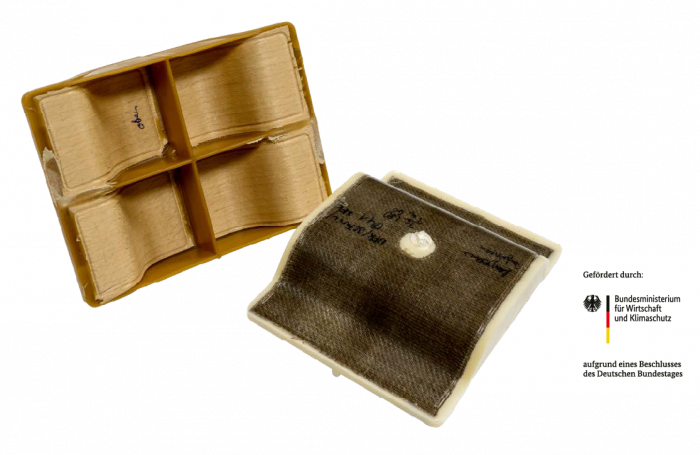
The goal was to produce a component from a trimmed, shaped wood veneer that is overmolded with plastic in an injection molding machine. In March 2023, this project officially concluded after a 2½-year project duration, and the result is an injection mold capable of producing such a component in several process steps but within a single cycle of the injection molding machine. First, a pretreated wood veneer is inserted into the mold and secured. As the mold closes, two edges of the veneer are trimmed — this occurs without the application of additional force, solely through the closing motion and the corresponding drives of the injection molding machine. The veneer is then formed by the build-up of mold clamping pressure within the machine. The trimmed and formed veneer is overmolded along its edges, and ribs are added to the inner curved surface for stabilization. In addition to wood veneers, this process was also tested using natural-fiber-reinforced organic sheets, and good results were achieved with these as well. In addition to geometry and determining technical feasibility, the project also focused on the question of whether a hybrid component could be created from renewable and biodegradable materials. The initial tests were therefore conducted not only with well-known engineering plastics such as PA 66, but also with plastics from the PLA group, which are produced from renewable resources such as cornstarch. The compostability of the component and the plastics themselves cannot be confirmed in general; therefore, no conclusive result is available regarding this specific issue. Nevertheless, the project can be considered a success, as important insights into the geometry of the components were gained and, above all, the manufacturability of such wood-plastic hybrid composites can be clearly affirmed. Both the Technical University of Braunschweig and Werner Schmid are interested in further developing the process in another joint project and will explore options for continuing the work.